
Short answer: A 777 game paytable explains which symbol combinations qualify for a return and how that return is calculated. Depending on the game, it may also describe paylines, wild symbols, scatter symbols, bonus features and maximum awards.
What Is a 777 Game Paytable?
There is no universal 777 paytable. The number “777” can appear in the names of unrelated games with different developers and mechanics. One game might use three reels and a single winning line, while another uses five reels, several paylines or clusters of matching symbols.
Before applying any calculation, identify the exact game and mode. A paytable copied from another app may use a different credit value, combination requirement or multiplier basis.
This guide uses fictional virtual-credit examples to explain the arithmetic. None of the example amounts should be treated as an actual Yono game offer.
Where to Find the Paytable
Look inside the game for an information icon, question mark, Help menu, Rules page or Paytable button. Open it before starting a round.
Some games separate symbol values from feature rules. The first screen may show what three matching symbols return, while later pages explain wild substitutions, bonus rounds or eligibility restrictions.
Read the full help section, including any notes below the symbol illustrations. A large “100×” label is incomplete unless the rules explain what amount is multiplied.
The UK Gambling Commission’s rules and game-description standard provides a useful example of the information regulated games should communicate. It does not establish that an unidentified 777 app is licensed or covered by that standard.
Start With the Unit of Value
A paytable may express awards in points, credits, coins or a multiple of a selected stake. These units are not automatically interchangeable.
If a game displays “20,” determine whether it means 20 credits, 20 times the line stake or 20 times the total round stake. The difference can be substantial.
Also check whether the numbers adjust when you change the selected amount. Some paytables display multipliers that remain constant. Others display the calculated award for the current setting.
Virtual credits should not be described as withdrawable money unless verified terms expressly establish that relationship.
Worked Example: A Simple Three-Reel Paytable
Assume a fictional game has one active payline, costs 10 virtual credits per round and uses the following rules:
| Combination on the active line | Return multiplier |
|---|---|
| Three cherries | 2× the round cost |
| Three bells | 5× the round cost |
| Three stars | 10× the round cost |
| Three sevens | 20× the round cost |
| Any other combination | No return |
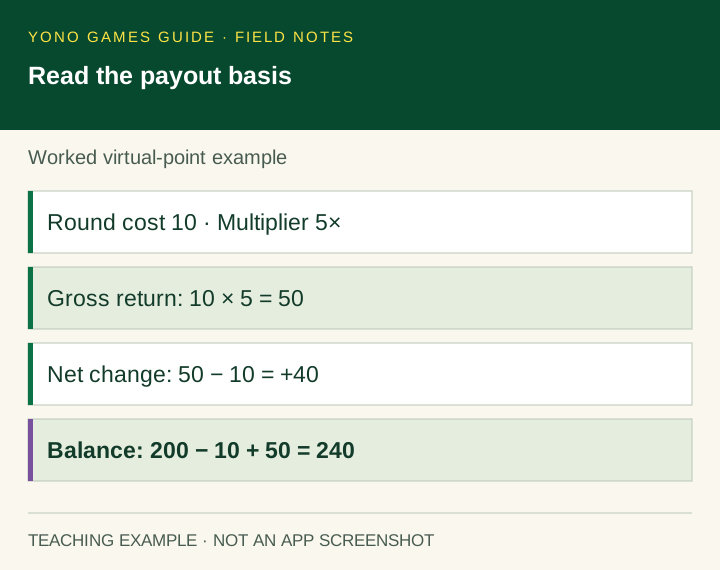
If three bells appear on the active line, the gross return is:
10 credits × 5 = 50 credits
The net change after accounting for the round cost is:
50 credits − 10 credits = +40 credits
If the player began with 200 credits, the balance would become 240 credits after the cost and return are applied.
This example assumes the multiplier describes the full amount credited. If another game defines an award as profit plus the original stake, its accounting will differ. Read the definition rather than assuming the displayed return includes or excludes the original cost.
Paylines: Matching Symbols Must Be in the Right Places
A payline is a predefined route across the reels. It can run straight across a row or follow a zigzag pattern.
Three matching symbols visible somewhere on the screen do not necessarily form a winning combination. They must satisfy the game’s placement and direction rules.
For example, a game may require matches to begin on the leftmost reel and continue across adjacent reels. Three bells on reels two, three and four may not count if the first reel does not form part of the combination.
Other games pay in both directions, use matching symbols on adjacent reels without fixed lines, or award connected clusters. These are different systems and should be evaluated using their own rules.
Worked Example: Line Stake vs Total Stake
Consider a fictional game with five active paylines. Each line costs two credits, making the total round cost ten credits.
One active line produces a combination worth 15 times the line stake.
Winning-line return = 2 × 15 = 30 credits
Net round change = 30 − 10 = +20 credits
Multiplying 15 by the total round cost would incorrectly produce 150 credits.
If two separate lines qualify for awards of 30 credits and 10 credits, and the rules allow both to pay, the combined return is 40 credits. The net change is then 30 credits after subtracting the ten-credit round cost.
Check whether overlapping combinations are added or whether only the highest qualifying combination on each line pays.
Wild Symbols and Their Limits
A wild symbol may substitute for another symbol to complete a combination. However, its substitution powers are defined by the paytable.
A fictional rule could allow a wild to replace cherries, bells or stars, but exclude sevens and scatters. Under that rule, Bell–Wild–Bell would count as three bells, while Seven–Wild–Seven would not count as three sevens.
Some wilds carry multipliers. Others expand, remain in place for several rounds or appear only during a feature.
Never assume that two multiplier wilds combine in a particular way. A 2× wild and a 3× wild might produce a 6× multiplier, a 5× multiplier or another result depending on the published calculation.
Scatter Symbols and Bonus Triggers
Scatters often work differently from ordinary line symbols. A game might count them anywhere on the reels, but that is a design choice rather than a universal rule.
Three scatters might trigger a feature, provide a direct credit return or do both. The help page should state whether four or five scatters increase the award.
A feature trigger is also different from a guaranteed return. Entering a bonus round does not necessarily produce the large amount shown in promotional artwork.
Check whether feature multipliers apply to all awards or only to specified combinations. If the rules distinguish a bonus meter from a payable balance, keep those values separate.
A Large Multiplier Does Not Reveal the Chance of Winning
A paytable tells you what qualifying outcomes return. It does not necessarily tell you how often they occur.
Two games can display the same 100× award while assigning very different probabilities to the relevant combination. Symbol appearance alone does not reveal those probabilities because virtual reels may use unequal weighting.
Similarly, a maximum-win headline is a ceiling under specified conditions. It is not a typical result or an amount every player can expect to receive.
A return-to-player figure, when supplied and properly substantiated, describes a theoretical long-run average. It does not promise a refund percentage for your next session.
Common Paytable Reading Mistakes
| Mistake | What to check instead |
|---|---|
| Multiplying by the wrong amount | Line stake, total stake or credit denomination |
| Counting any visible match | Required positions and direction |
| Adding every overlapping combination | Highest-win and aggregation rules |
| Treating wilds as universal substitutes | Explicit exclusions |
| Assuming scatters always pay | Trigger rules and direct-award rules |
| Calling gross return profit | Subtract the complete round cost |
| Treating virtual coins as cash | Current terms for that specific balance |
These checks are most useful before play, while there is time to read the rules without pressure.
How to Record a Disputed Result
If a return appears incorrect, capture the complete result screen, selected amount, active paylines and relevant paytable page. Include the game title, mode, app version, round reference and time if available.
A cropped screenshot of three sevens may omit the information needed to evaluate the result. The symbols could be outside an active line or associated with a different feature.
Send the evidence through the support channel belonging to the identified application. Do not provide passwords, OTPs or payment PINs.
Frequently Asked Questions
Does 777 always produce the highest award?
No. Some games use sevens as a top symbol, while others assign the largest award to a different combination or feature.
Why did three matching symbols return nothing?
They may have appeared in the wrong positions, outside an active payline or without the required starting reel.
Is a 10× return ten times my total stake?
Only if the paytable says so. It could refer to the line stake or another defined unit.
Does the paytable prove a game is fair?
No. It describes intended rules. Verifying that software consistently follows those rules requires additional evidence.
Sources
To read a 777 game paytable correctly, identify the value unit, matching requirement and multiplier basis before calculating a return. Then check wild exceptions, scatter rules and how simultaneous awards are combined.
The name “777” does not establish one shared rulebook. Use the live paytable for the exact game, and treat virtual credits according to their stated terms.
Risk note: A paytable explains awards, not a method for guaranteeing them. Set limits on time and optional spending, and avoid increasing participation to recover earlier losses.