How arcade games work
Yono arcade games generally use shorter sessions, simple controls and a clear score, survival or level objective. A title may ask the player to move, match, collect, avoid or complete a task before time expires.
Similar Yono Arcade names do not guarantee identical gameplay, the same developer or the same account system.
Common arcade objectives
- Reach a target score.
- Complete a level.
- Survive for a set time.
- Collect specific items.
- Match symbols or patterns.
- Finish a task within a time limit.
What to review
| Feature | Question |
|---|---|
| Controls | Tap, swipe, drag or on-screen buttons? |
| Lives | How are attempts restored? |
| Scoring | Which actions add or remove points? |
| Difficulty | Does each level change speed or obstacles? |
| Connectivity | Can the title work offline? |
| Game mode | Free, social, virtual-coin or another mode? |
How levels and scoring may change
An arcade game can increase difficulty by shortening a timer, speeding up movement, adding obstacles, reducing lives or requiring a higher score. The next level may introduce a new control or objective, so instructions from the first stage should not automatically be applied to the entire game.
Scoring also needs context. Points may come from speed, accuracy, collected items, completed combinations or remaining time. Check whether a missed action removes points, ends a life or restarts the level. A clear Yono arcade game guide should explain both how points are earned and what condition completes the stage.
Choosing an arcade game mode
Look for a mode description before starting. Free practice, social competition, virtual-coin play and real-money modes carry different account and financial implications even when the on-screen game looks similar. Review entry conditions, reward descriptions, regional availability and age requirements separately.
Short sessions can still become repetitive. Decide how many rounds or how much time to use, then stop when the limit is reached. If an app uses energy, lives or virtual currency to encourage repeated play, understand how those items are restored and whether any purchase is optional before continuing.
Yono arcade formats compared
| Format | Primary objective | Progress signal | Common end condition |
|---|---|---|---|
| Score attack | Earn as many points as possible | Score counter or rank | Timer, lives or attempts end |
| Level clear | Complete a defined stage | Level number, checkpoint or goal | Exit, target or final task is reached |
| Survival | Continue without failing | Elapsed time, distance or remaining health | Health, lives or time run out |
| Collection | Gather specified items | Item counter or completion meter | Required total is collected |
| Matching | Create a valid symbol or pattern match | Matched sets, chain or board state | Target pattern or move limit is reached |
| Timed task | Finish an action sequence quickly | Countdown and task checklist | Task completes or timer expires |
What happens during a typical arcade session?
A typical arcade session begins with an objective and control prompt, moves through one or more attempts, records progress and ends when a target, timer, life or failure condition is reached. The useful questions are concrete: what input is accepted, what counts as progress, what removes a life, whether a restart resets the score and what unlocks the next level. Short animation and bright feedback can make a game feel intuitive, but they do not replace a written objective. Before comparing two Yono arcade games, check the complete session loop rather than assuming that similar icons or lobby placement mean the titles work alike.
- Read the objective before the first attempt.
- Test each control in a practice or non-money mode when available.
- Note how score, lives, energy and checkpoints change.
- Confirm the exact completion and failure conditions.
Controls, accessibility and device fit
| Check | Why it matters |
|---|---|
| Touch target size | Small or closely spaced controls can cause unintended input |
| Orientation | Portrait and landscape layouts may use different control positions |
| Text and contrast | Objectives, timers and warnings must remain readable |
| Sound and vibration | Important state changes should not rely on audio alone |
| Pause behaviour | A timer may continue while a menu or interruption is open |
| Network recovery | The rules should explain what happens after a connection loss |
Offline, social and connected modes
An offline arcade title can often run a local level without an account, while a connected title may use leaderboards, cloud progress, multiplayer events or advertisements. “Offline” should be checked in practice because a game may open without a connection but still require one to save progress, restore lives or load later stages.
Social and virtual-coin modes also need separate reading. A leaderboard measures results under its own scoring rules; it does not prove that every participant used the same device conditions. Review account permissions, data use and whether purchases or money-linked features are present before treating a casual-looking title as low risk.
A practical arcade review method
Our review method records the objective, controls, scoring action, difficulty change, end condition, connection requirement and game mode for the exact title. We then separate those gameplay facts from the developer, package ID and privacy-policy record. This prevents a familiar Yono Arcade name from being treated as proof of one shared product.
The page is rechecked when a material game-mode definition changes, a reliable correction is received or linked policy context changes. Otherwise, it follows a quarterly editorial review. Readers reporting an issue should include the exact title, version, device orientation, relevant screen and the written rule that appears inconsistent.
Read how we check app developersSubmit an editorial correction
Worked example: a high score does not always clear a level
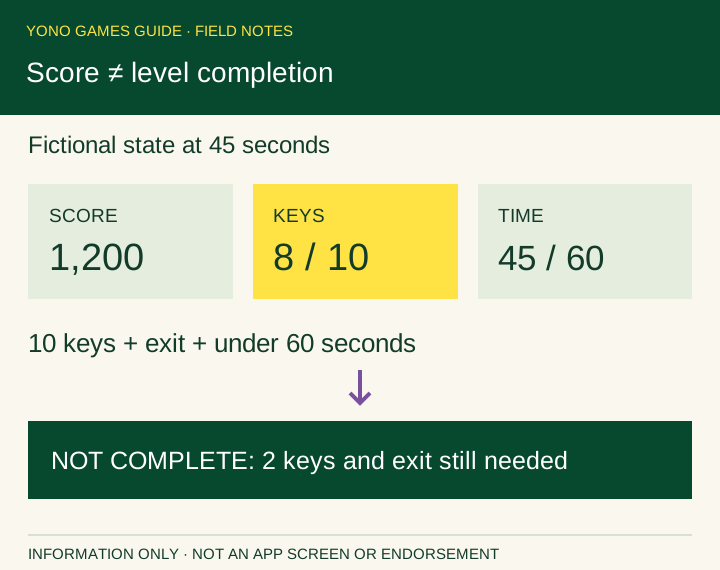
Imagine a fictional collection level with three requirements: collect 10 keys, reach the exit and finish before a 60-second timer ends. At 45 seconds the player has 1,200 points but only 8 keys. The score is high, yet the collection objective is incomplete. At 55 seconds, collecting the tenth key still does not clear the level until the exit is reached.
This example separates score, progress and completion. Read whether the conditions are joined by “and” or “or”; do not substitute a points target for an item target. The example is illustrative, not a description of a verified Yono title.
How score multipliers and bonuses change totalsHow lives, energy and continues differ
What to record when progress or a leaderboard looks wrong
Before repeating a run, record the mode, level, app version, device, connection state and the score shown at the end. Note whether the game displayed a save or submission confirmation. A score that is visible locally may not yet be recorded on a connected leaderboard; avoid claiming cheating or lost progress from one screen alone.
| What you see | Useful next check |
|---|---|
| High score, level not complete | Check item, exit, time and survival requirements |
| Different totals after similar runs | Compare bonus eligibility, combo reset and penalties |
| Score missing online | Check submission status, account, filters and connection |
| Rank changed the next day | Check the leaderboard time window and reset timezone |
| Progress changed after continuing | Check whether continue resets score or eligibility |
A platform example, not a universal Yono rule
Google Play Games Services documents daily, weekly and all-time leaderboards, and allows games to rank either larger or smaller values first. This illustrates why a leaderboard needs a time window and a scoring direction: a racing time can rank differently from a points total.
This does not establish that a Yono-branded title uses Google Play Games Services. Apply only the rules stated by the exact title. When asking its verified support channel about a result, send the relevant non-sensitive details rather than an account password, OTP or payment credential.
Primary sources: Android Developers: leaderboard timeframes and ordering
Frequently asked questions
What are Yono Arcade Games?
Yono Arcade Games is a broad description for short mobile challenges based on scores, levels, timing, movement, matching, collection or survival objectives.
Do all Yono arcade titles use the same controls?
No. Controls can use taps, swipes, dragging, virtual buttons or device movement and should be checked for the exact title.
How is an arcade level completed?
Completion may require a target score, exit, collected-item total, survival time, matching pattern or final task. The game’s own objective defines the condition.
Can a Yono arcade game work offline?
Some titles or levels may work offline, while saving, leaderboards, advertisements or later stages may require a connection. Test the specific mode rather than relying on the label.
What is the difference between score and progress?
Score measures points earned under a rule. Progress shows movement toward a level, checkpoint, distance, collection total or other objective; the two are not always the same.
How often is this arcade guide reviewed?
It is reviewed after material gameplay or source changes and on a quarterly editorial schedule. Dates are changed only after a manual review.
Yono Games Guide provides independent information only. We do not host APK files, operate third-party games or process payments.