
Short answer: For a properly implemented game with independent random rounds, previous results do not reveal what will happen next. A sequence of losses does not make a win due, and a recent large award does not automatically prevent another one.
Can You Predict the Next 777 Game Result?
However, “777 game” is a broad label. Some games have persistent bonus meters, fixed decks, collection features or changing modes. Those mechanics can create state that carries between rounds.
The correct starting point is therefore the game’s rules. Identify whether rounds are independent and whether the conditions remain unchanged.
This article explains the mathematics of independence. It does not certify the random-number system of any particular Yono-branded application.
What Does an Independent Round Mean?
Two rounds are independent when knowing the result of one does not change the probability of the other.
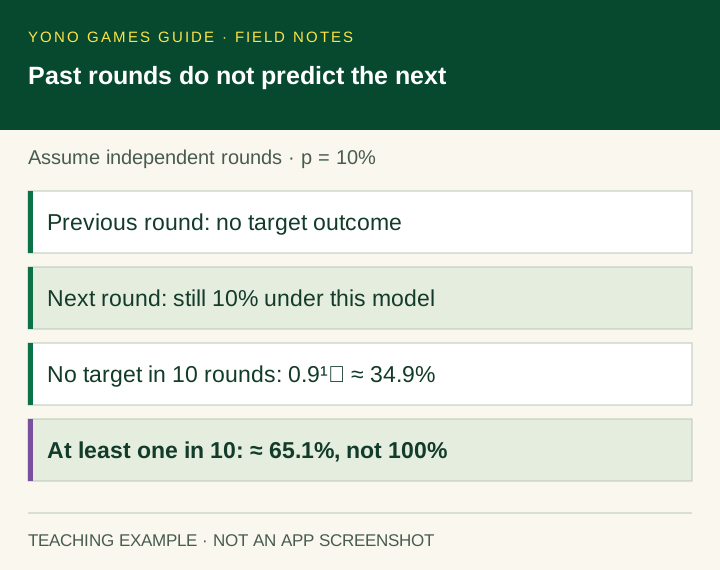
Suppose a fictional game has a 10% chance of a qualifying award on every round. Assume that the probability stays fixed and rounds are independent.
The chance of an award on the next round is 10% after one loss, five losses or twenty losses. The previous outcomes have already happened. They do not create a credit that the game must repay.
Independence also means a win does not use up the next round’s chance. The probability remains 10% after a win under the same assumptions.
Random Does Not Mean Every Outcome Is Equally Likely
A random result can still have unequal probabilities.
Imagine a wheel with ten equally likely positions: six blue, three green and one gold. The outcome is random, but blue occurs with probability 60%, green with 30% and gold with 10%.
A symbol game may similarly give common symbols more weight than rare symbols. Seeing three symbol types does not imply that each appears one-third of the time.
This distinction matters when users estimate odds from artwork. The number of symbols visible in the paytable is not enough to calculate their probabilities.
Worked Example: Ten Rounds Without an Award
Continue with the fictional game where each round has a 10% award probability.
The probability of no award on one round is 90%, or 0.9. The probability of no award in ten independent rounds is:
0.9¹⁰ ≈ 0.3487, or 34.87%
A ten-round losing run is therefore quite possible in this example.
After those ten losses, the probability of an award on round eleven is still 10%. The 34.87% calculation describes the chance of the completed ten-round sequence. It does not change the next trial.
These numbers are teaching assumptions, not measured odds for an actual 777 app.
Worked Example: At Least One Award
The probability of at least one award in ten rounds is the complement of no awards:
1 − 0.9¹⁰ ≈ 65.13%
This does not mean the player has a 65.13% chance of making a profit. An award could be smaller than the total cost of playing ten rounds.
It also does not mean ten rounds are a sensible target. The calculation describes a hypothetical event over a chosen number of trials; it does not recommend continuing until an award appears.
Probability of any return, probability of a large return and probability of a profitable session are separate questions.
The “A Win Is Due” Myth
The belief that a long losing streak must be followed by a win is often called the gambler’s fallacy.
It comes from confusing long-run averages with short-run correction. An independent process can produce uneven stretches without compensating for them immediately.
Suppose the hypothetical 10% game produces no awards in its first twenty rounds. There is no rule requiring two awards in the next twenty to make the earlier average look better.
Adding more rounds can make an observed average more stable over a large sample, but it does not erase past losses or guarantee a particular future sequence.
The “Hot Game” Myth
The opposite belief is that a game becomes more likely to produce awards because it recently produced several.
A short sequence of wins may look meaningful, especially when shared in a video. Under a fixed independent model, however, those wins do not establish a temporary hot state.
Players should distinguish random streaks from a documented feature change. Entering a bonus mode with published different rules is relevant. A promoter calling a normal table “hot” without evidence is not.
Does a Near Miss Mean the Next Round Is Better?
A near miss is an outcome that looks close to a desired combination, such as two sevens and a different final symbol.
Visual closeness does not necessarily correspond to mathematical closeness. If rounds are independent, a near miss does not push the next round closer to success.
Animation can make a result feel dramatic by slowing the last reel or highlighting matching symbols. That presentation does not establish that timing your next tap improves the probability.
If player timing genuinely affects a skill-based mechanic, the rules should explain the interaction. Do not assume that a stop animation gives control over a random result.
What a Random-Number Standard Can Establish
The UK Gambling Commission’s standard for generating random outcomes describes expectations such as unpredictability and results consistent with theoretical probabilities for products within its scope.
That is a useful reference for understanding what a formal standard looks like. It is not evidence that every app using “777” has been tested against it.
An actual verification claim should identify the operator, game, testing body, certificate scope and relevant software version. A badge reading “RNG certified” without a traceable record is incomplete evidence.
When Earlier Game State Can Matter
Not every game resets all conditions after a round.
| Mechanic | What may carry forward |
|---|---|
| Collection feature | Previously collected symbols or items |
| Bonus meter | Progress toward a stated threshold |
| Persistent wild | A symbol retained for later rounds |
| Deck without replacement | Cards already removed |
| Level progression | Difficulty or available targets |
| Documented guarantee counter | Progress toward a specified reward |
These mechanics should be explained in the rules. They do not mean that every result becomes predictable.
A meter might guarantee entry to a feature while leaving the feature’s award random. A shrinking deck can change probabilities without revealing the next card. Read the exact condition rather than assuming complete independence or complete predictability.
RTP Is Not a Session Forecast
A theoretical return-to-player percentage concerns an average across a very large amount of play under the model’s assumptions.
For illustration, a 96% theoretical RTP means expected gross returns of 96 units for each 100 units staked over the long run. It does not mean a player receives 96 units back after spending exactly 100.
Actual short sessions can finish far above or below that average. Volatility, award probabilities and feature structure influence the spread of possible results.
Do not use an RTP number as a spending budget or assume that a losing session must eventually recover to the advertised percentage.
How to Assess a Prediction Claim
A credible prediction test requires more than a screenshot showing one correct guess.
The method should be specified before the results are known, tested on new rounds and compared with a suitable baseline. All predictions should count, including failures.
A page that changes its signals after each result, deletes wrong predictions or publishes only selected wins cannot demonstrate accuracy.
Do not install a prediction APK or give someone account access to test a claim. A supposed signal service may earn referral income, collect payments or capture credentials regardless of whether its predictions work.
Frequently Asked Questions
Can previous results predict independent rounds?
No. Under independence with unchanged conditions, past results do not alter the next-round probabilities.
Does random mean fair?
Not automatically. Fairness also depends on whether the implemented probabilities and awards match the published rules.
Does changing the stake improve the chance?
Only if the rules explicitly establish a change in eligibility or probability. A larger stake often changes the amount at risk rather than the odds.
Should I keep playing after a losing streak?
A losing streak does not create a mathematical obligation for the next round to return anything. Follow your original limits.
Sources
Independent 777 game rounds cannot be predicted from visible streaks alone. Losing runs, clusters of awards and near misses can all occur in random processes.
Check for documented features that carry state between rounds, and separate a publisher’s claims from independently verifiable evidence. No pattern chart should be treated as a guarantee of income.
Risk note: Set a session limit before playing. Stop at that limit even when a win feels due, and avoid paid signals or tools promising guaranteed results.