
Short answer: Arcade games often display hearts, lightning bolts, tickets, timers and Continue buttons. These elements can control different parts of play.
Why Do Arcade Games Use Different Limits?
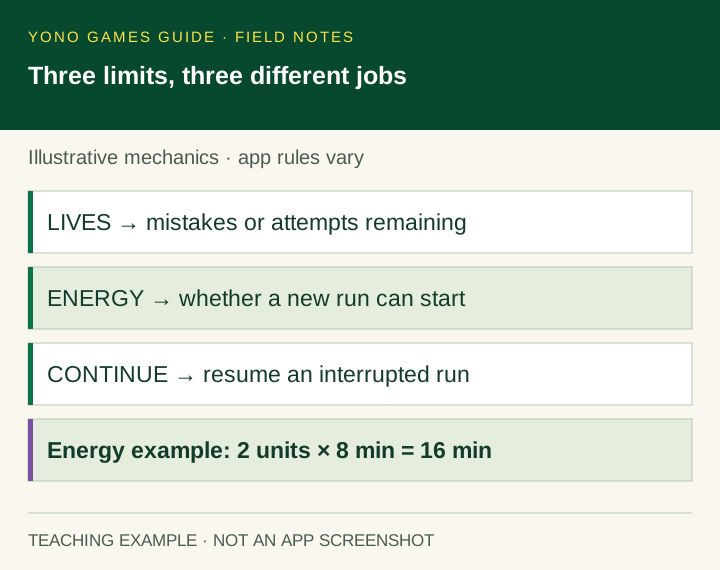
Lives may represent remaining mistakes or attempts. Energy may determine whether you can start a stage. A continue may let you resume after failure.
The symbols are not standardized. A heart can represent health in one game and level attempts in another. A lightning bolt can represent entry energy, a special move or a temporary power-up.
For Yono arcade games, identify the exact app and read the explanation next to the relevant icon. Do not assume that another app using similar artwork follows the same rules.
Lives, Health, Energy and Continues Compared
| Resource | Typical purpose | Question to ask |
|---|---|---|
| Health | Absorbs damage during a run | What happens when it reaches zero? |
| Lives | Counts retries or permitted failures | Is one lost per death or failed level? |
| Energy | Pays for starting or entering an activity | How much does each activity cost? |
| Ticket | Grants entry to a specific mode | Does it expire or replenish? |
| Continue | Resumes after a failure | What progress and score are retained? |
| Booster | Changes an action or advantage | Does using it consume a separate resource? |
These are general definitions. The game’s actual labels may differ.
Lives Can Mean Two Different Things
In a traditional arcade design, a player may start a run with three lives. Each death removes one. Losing the final life ends that run.
In some mobile games, lives instead represent attempts at a level. A failed level consumes one life, while successful completion may preserve it.
These models produce different expectations. If you lose several hearts after one collision, the hearts may represent health rather than individual attempts.
Open the help page or observe a simple practice run to determine which resource is changing and when.
Worked Example: Lives Within One Run
Consider a fictional game that gives three lives at the start. Every collision costs one life, and the score persists until all lives are lost.
After the first collision, two lives remain. After the second, one remains. The third collision ends the run.
If the game offers a continue, accepting it may restore a life, restart the current stage or resume at a checkpoint. Those are separate design choices.
The continue may also affect score eligibility. A casual mode might retain the score, while a competitive board excludes continued runs. Check this before using a limited continue token.
How Energy Works
Energy commonly controls access to an activity. A stage might require five energy units, while another requires ten.
The game may deduct energy when you press Start, when the level loads or when the attempt ends. Some games refund it after a technical interruption; others have different policies.
The cost can also depend on the mode. Ordinary levels, event stages and challenge rooms may use separate energy balances.
A player can therefore have enough energy for one activity but not another. Always read the cost beside the specific entry button.
Worked Example: Energy Recovery Time
Assume a fictional game has a maximum of 30 energy, restores one unit every six minutes and requires five energy to start a stage.
You currently have two energy, and the next unit is due in four minutes.
To reach five energy, you need three units:
First unit: four minutes
Second unit: six additional minutes
Third unit: six additional minutes
Total waiting time = 16 minutes
Simply calculating three units times six minutes would produce eighteen minutes and ignore the recovery timer already in progress.
The example assumes uninterrupted recovery and no other source of energy.
Recovery Stops at a Cap Unless the Rules Say Otherwise
If a game has a natural energy cap, timed recovery may stop once the balance reaches it.
Suppose energy reaches 30 at 10:00. Returning at 14:00 does not necessarily give four extra hours of accumulated energy. Under a stop-at-cap rule, the balance remains 30.
Purchased refills or event rewards may be allowed to exceed the natural cap, but that must be checked separately.
An “energy full” notification also does not mean the game will store missed recovery indefinitely. Read whether the app supports overflow, reserve energy or a separate reward inbox.
Full Refills vs Fixed Refills
A full refill and a fixed energy pack are not always equivalent.
Imagine a 30-energy cap and a current balance of 22.
A refill “to full” adds eight energy. A fixed pack of ten may add ten, or only eight if the game clips additions at the cap. A third design may allow the balance to reach 32.
| Refill description | Possible result from 22/30 |
|---|---|
| Restore to maximum | 30 |
| Add 10, cap enforced | 30 |
| Add 10, overflow allowed | 32 |
Before using a scarce reward or making a purchase, confirm the rule. The icon alone may not explain whether any excess is lost.
What “Unlimited Lives” Usually Needs You to Check
An unlimited-lives item often lasts for a fixed period rather than permanently removing restrictions.
A thirty-minute reward might start immediately when claimed. Its timer could continue while the app is closed, or it could count only active play. Neither behavior should be assumed.
It may also apply only to ordinary level attempts. Event tickets, energy costs and ranked-mode restrictions could remain separate.
Before claiming the item, read the duration, eligible mode, start condition and whether the timer can pause. A reward that begins immediately may be less useful if you cannot play during that window.
Continues and Their Hidden Trade-Offs
A continue lets the player resume after failure, but its value depends on what is restored.
It may grant additional time, one life, a few extra moves or a checkpoint restart. The game may preserve the score while resetting a combo, or preserve the level position while reducing the final rating.
Some continues cost virtual currency, use a token or require an advertisement. Others may be offered as a paid option.
Read the confirmation panel before accepting. “Continue” is not a promise that every part of the previous state will remain unchanged.
Rewarded Ads: Check the Actual Credit
If an app offers energy or lives for watching an advertisement, look for the completion confirmation and updated balance.
A closed advertisement, interrupted network connection or failure to return to the game can prevent the reward flow from finishing. Do not assume that every visible ad impression qualifies.
If the expected reward does not appear, record the time, offered amount, relevant screen and app version. Restart the lobby once and check the balance before attempting the same offer repeatedly.
Do not install a separate app claiming to unlock ad rewards unless it is part of a clearly explained, trustworthy offer you independently choose to use.
Why Energy May Differ Between Devices
A guest account on one phone may not be the same account used on another. Local display delays, offline play and synchronization can also create temporary differences.
Check the player ID and login method first. Then reconnect to a stable network and allow the app to refresh.
Changing the device clock to speed up recovery is unreliable. The game may use server time, and altering the clock can create incorrect timers or account problems.
Avoid clearing app data as an initial fix. An unlinked guest profile may depend on local storage.
What to Record When a Resource Is Missing
A useful report includes the balance before and after the issue, the level or event, the time, the app version and any purchase or reward reference.
Explain whether the resource disappeared when entering, failing, reconnecting or claiming a refill. These details help distinguish expected consumption from a possible error.
Hide passwords, one-time codes and payment credentials. A resource-recovery request should not require giving someone remote control of your phone.
Frequently Asked Questions
Are lives and energy the same thing?
They can be separate. Lives often limit failures, while energy often limits activity entry.
Does energy recover while the app is closed?
Many designs allow it, but the current game rules determine recovery behavior.
Does a continue preserve leaderboard eligibility?
Not necessarily. Competitive modes may exclude continued runs or use separate boards.
Will buying a refill guarantee level completion?
No. A refill provides another opportunity to play, not a guaranteed result.
Lives, energy and continues control different aspects of arcade play. Identify when each resource is consumed, how it recovers, whether a cap applies and what a continue preserves.
Understanding those details helps you interpret timers, use rewards sensibly and report genuine balance problems.
Spending note: Set a limit before purchasing retries or refills. Repeated failure does not make the next paid attempt certain to succeed, and it is reasonable to stop and return later.