
Short answer: An arcade leaderboard orders players according to a defined result. That result might be a high score, fastest completion time, longest survival period, number of objectives completed or total points earned during an event.
What Does an Arcade Leaderboard Measure?
The ranking is meaningful only when you know the metric.
A player listed first on a fastest-time board has a lower number than other players. A player first on a high-score board usually has a higher number. A weekly activity board may reward cumulative participation rather than one exceptional run.
Yono arcade applications can use different systems. There is no universal leaderboard formula associated with the word “Yono.”
Read the Leaderboard Name and Filters First
Before comparing positions, check the board’s title, mode, difficulty, time period and audience.
A friends-only board may contain ten people, while the global board contains thousands. Your rank can differ even when your submitted score is identical.
A level-specific board also cannot be compared directly with an overall progression board. One may evaluate a single stage, while the other adds achievements across several stages.
| Board type | Common measurement |
|---|---|
| High score | Best eligible run |
| Time trial | Fastest eligible completion |
| Survival | Longest time or most waves survived |
| Daily challenge | Result within one daily event |
| Weekly total | Sum of qualifying points |
| Friends | Results within a selected social group |
| Seasonal league | Event points or a separate rating |
These are possible designs, not confirmed features of every arcade app.
Best Score vs Cumulative Score
Suppose a player finishes three eligible runs with scores of 8,000, 12,000 and 10,000.
A best-score leaderboard records 12,000. A cumulative leaderboard records 30,000. A latest-run board records 10,000.
All three use the same gameplay results but answer different questions.
This distinction explains why a new run may fail to move a best-score position. A score of 10,000 does not improve a previous 12,000 result.
Google’s official leaderboard documentation describes one implementation that compares submitted results with a player’s current daily, weekly and all-time bests. This is an example of a platform design; it does not prove an unidentified Yono app uses Google’s leaderboard service.
Worked Example: Ranking Four Players
Assume a fictional weekly board adds all eligible run scores.
| Player | Run one | Run two | Weekly total | Position |
|---|---|---|---|---|
| Asha | 12,000 | 8,000 | 20,000 | 1 |
| Dev | 9,000 | 9,000 | 18,000 | 2 |
| Mira | 15,000 | 2,000 | 17,000 | 3 |
| Ravi | 7,000 | 6,000 | 13,000 | 4 |
Mira has the strongest single run but ranks third on the cumulative board.
If the same game used best-run scoring, Mira would rank first with 15,000 and Asha second with 12,000. Reading the metric prevents a perfectly valid ranking from looking like an error.
How Tied Scores Are Ranked
Equal scores can produce shared positions or trigger a secondary comparison.
Two common shared-rank displays are competition ranking and dense ranking.
| Scores | Competition ranking | Dense ranking |
|---|---|---|
| 10,000 | 1 | 1 |
| 9,000 | 2 | 2 |
| 9,000 | 2 | 2 |
| 8,000 | 4 | 3 |
Competition ranking skips the position occupied by the second tied player. Dense ranking moves directly to the next distinct score.
A game may instead award separate positions using completion time, fewer continues, higher accuracy or the timestamp when the score was recorded. None of these should be assumed without the event rules.
Displayed Ties May Hide Additional Precision
A leaderboard might round scores or times for display while retaining a more precise internal value.
For example, two players may both appear to finish in 45.3 seconds. Their recorded times could be 45.271 and 45.349 seconds.
The first player can rank higher without any additional tie-break because the stored results are different.
The same issue can occur with abbreviated scores such as “1.2M.” That label may conceal a difference of thousands of points.
Before reporting an unfair tie decision, open the detailed result view if the game provides one.
Daily, Weekly and Seasonal Resets
A reset starts a new ranking period. It may clear the current board while preserving historical scores elsewhere.
Daily does not necessarily mean midnight in the player’s local time. The event can use a fixed server timezone.
For a fictional event resetting at 00:00 UTC, the corresponding time in India is 05:30 IST. A player checking at midnight in India would still be inside the previous UTC day.
Weekly events also need a defined starting day. “Weekly” alone does not tell you whether the period runs Monday to Sunday or uses another schedule.
Read the event’s countdown together with the written timezone and date.
When a Run Crosses the Reset Time
Suppose a run starts five minutes before the weekly deadline and finishes two minutes after it.
The game may assign it according to start time, completion time or server receipt time. It may also prohibit late completion entirely.
This rule affects both ranking and rewards. A visible score earned before the timer ends may still require a successful final submission.
If the deadline matters, allow time for the run to finish and synchronize. Do not depend on changing your device clock; leaderboard periods are often controlled by the server, and clock changes can create additional problems.
Why a Score Has Not Appeared
Delayed submission does not automatically mean a result has been lost.
Possible explanations include an interrupted connection, offline play awaiting upload, an unfinished run, an ineligible mode or a score that did not beat the existing record.
A result can also be held for validation or excluded from public display by account settings.
| Situation | First check |
|---|---|
| Score missing everywhere | Did the run finish and save? |
| Personal best visible, rank absent | Correct board and visibility settings |
| Lower score still shown | Refresh timing and account identity |
| Event score missing | Event window and eligible mode |
| Offline run absent | Whether offline submissions are supported |
| Rank changed after closure | Final validation and published event rules |
Capture the final result before starting another run if the app appears unstable.
Leaderboard Position and Rewards
A rank display is not necessarily a reward promise. Some boards exist only for comparison.
If an event offers rewards, review the finalization time, eligible ranks, tie treatment, claim deadline and reward type.
A temporary first place can change before the event closes. A provisional result may also change after invalid submissions are removed or delayed results are processed according to the rules.
Points, badges, tickets and virtual coins should be described separately. A high score does not establish a cash-out balance.
Suspicious Scores and Fair-Play Reports
An unusually high score deserves examination, but it is not proof of cheating by itself. A different mode, long play session, score multiplier or display abbreviation may explain the number.
Useful reports identify the board, player entry, score, timestamp and the specific rule that appears inconsistent.
Avoid public accusations based only on surprise. Submit evidence through the identified game’s support channel.
Also avoid leaderboard services selling guaranteed placement. They may use account sharing, automation or manipulated submissions that violate the game’s rules and put your account at risk.
How to Compare Your Own Progress
For personal improvement, keep the conditions consistent. Compare runs on the same level, difficulty and version, with the same boost and continue rules.
Record a few meaningful measures such as completion rate, best score and average mistakes. A leaderboard position can fall even while your own performance improves because other players also progress.
This makes personal results a useful complement to public rankings.
Frequently Asked Questions
Why did my rank fall without my score changing?
Other players may have submitted better results, or the board may have refreshed.
Does a reset delete my personal best?
Not necessarily. A daily or weekly board can reset while an all-time record remains.
Who wins when two scores are equal?
The published ranking and reward rules decide. Shared rank and a secondary tie-break are both possible.
Why is a smaller number ranked first?
The board may measure completion time, penalties or another result where lower is better.
Sources
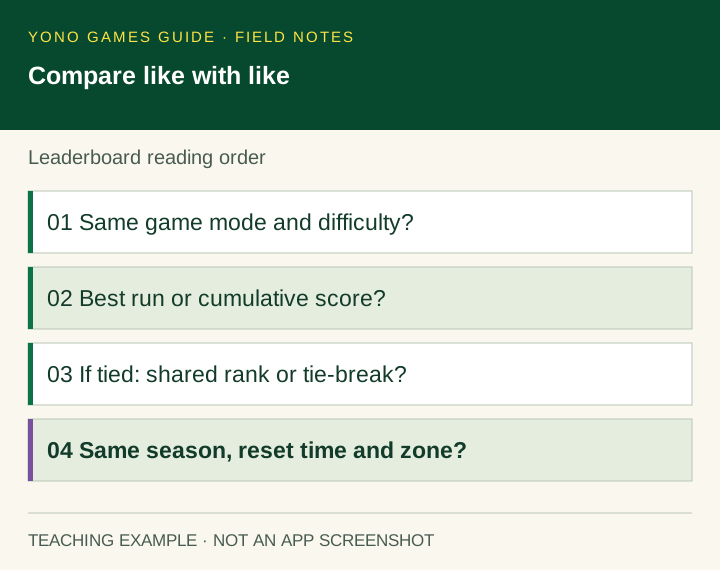
Arcade leaderboards depend on four essentials: what is measured, which runs qualify, how ties are handled and when the ranking period ends.
Read those rules before interpreting a position or expecting a reward. If a result looks wrong, collect the complete run summary and board details so support can assess the same evidence.
Spending note: A leaderboard can encourage repeated attempts and optional purchases. Set time and spending limits independently of your current position.