
Short answer: A rummy declaration can be invalid even when most of the hand is organised correctly. One missing pure sequence, one ungrouped card or one incorrect set may be enough to make the entire declaration fail.
The safest way to check a hand is to separate two questions: does each group work on its own, and does the collection of groups satisfy the full declaration rules?
This guide uses common 13-card Indian Rummy conventions: at least two sequences, including at least one pure sequence, with all thirteen cards arranged into permitted sequences and sets. Published Indian Rummy rules describe this sequence requirement, but the live rules of your table remain the deciding reference. RummyCircle declaration guide.
Scoring, finish buttons and some joker rules vary. The examples below focus on the structural reasons a declaration fails.
Start by Counting the Cards
Count the cards included in the final declaration. Under the format used here, there should be thirteen, with each physical card used once.
During a normal draw-and-discard turn, you may briefly hold fourteen cards. Check which card you are discarding or placing into the finish area according to the app’s process.
A card you intend to discard cannot also complete a sequence in the declared hand.
Likewise, two overlapping runs cannot share one physical card. If 4♥–5♥–6♥ and 6♥–7♥–8♥ depend on the same six of hearts, they are not two separate groups.
Count the actual cards, not the combinations you can imagine.
The 13-Card Declaration Checklist
| Check | What must be true | Typical failure |
|---|---|---|
| Final count | Thirteen cards are included | Fourteen remain, or one is omitted |
| Card allocation | Each card appears in one group | A card is counted in two runs |
| Sequence count | At least two qualifying sequences | Only one sequence and several sets |
| Pure sequence | At least one qualifying pure run | Every run needs a substitute |
| Sequence length | Each run meets the minimum | A two-card partial run is submitted |
| Rank order | Sequence ranks are consecutive | A gap remains |
| Suit consistency | Natural sequence cards fit one suit | Same colour is mistaken for same suit |
| Set structure | Matching ranks with permitted suits | Duplicate same-suit cards in one ordinary set |
| Joker assignment | Each joker fills one legal role | One joker covers multiple gaps |
| Ace position | Accepted high or low use | K–A–2 is treated as a run |
| Remaining cards | Every card belongs to a valid group | One unmatched card remains |
| Submitted layout | The app receives the intended grouping | Display order differs from submitted groups |
Use the checklist in order. Checking the overall count and required sequences first can reveal a problem before you spend time comparing every set.
Example 1: A Complete Valid Declaration
Assume no relevant wild-rank substitutions are involved.
| Group | Cards | Type | Count |
|---|---|---|---|
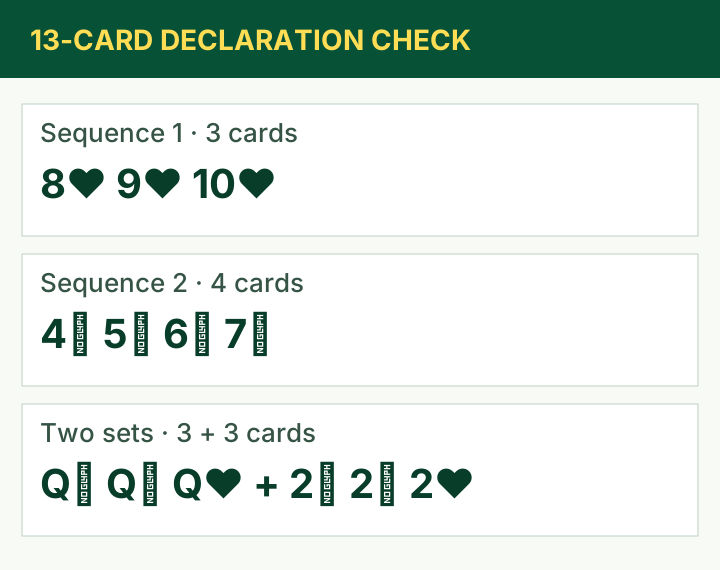
| 1 | 8♥–9♥–10♥ | Pure sequence | 3 |
| 2 | 4♣–5♣–6♣–7♣ | Pure sequence | 4 |
| 3 | Q♦–Q♠–Q♥ | Set | 3 |
| 4 | 2♦–2♣–2♥ | Set | 3 |
| Total | All cards used once | Valid under stated rules | 13 |
This hand contains two sequences, both pure. The remaining cards form two ordinary sets.
An impure sequence is unnecessary because the minimum sequence requirement is already satisfied. Two pure sequences are acceptable under the convention used here.
The example also shows that the groups do not need equal lengths.
Example 2: Two Sequences, but No Pure Sequence
Assume kings are wild.
Group 1: 3♥–PJ–5♥ Group 2: 8♣–9♣–K♦ Group 3: Q♣–Q♦–Q♥ Group 4: 2♣–2♦–2♥–2♠
The total is thirteen cards.
The printed joker completes the first run as 4♥. The king of diamonds completes the second as 10♣. Both sequences are impure.
The queen and two groups are valid sets, but they do not solve the absence of a pure sequence. This declaration is invalid under the stated rules.
Counting two runs is therefore insufficient. At least one must meet the pure-sequence requirement.
Example 3: One Long Sequence Does Not Automatically Count as Two
Consider this hand:
Group 1: 3♥–4♥–5♥–6♥ Group 2: 8♣–8♦–8♥ Group 3: J♣–J♦–J♥ Group 4: K♣–K♦–K♠
Assume none of these cards are being used as wild substitutes.
Every group is individually valid, and the total is thirteen. However, there is only one sequence.
The four-card run cannot be divided into two groups of at least three cards. The declaration therefore fails the minimum sequence count.
This is a useful example because nothing looks visibly broken. The error exists at the whole-hand level rather than inside a group.
Example 4: A Duplicate Suit Makes an Ordinary Set Invalid
Suppose a multiple-deck game gives you two copies of 9♣.
You group 9♣–9♣–9♦ together because all three cards are nines. Under the ordinary set convention used here, that group is invalid: it repeats the same suit.
A valid natural set would use matching ranks in different suits, such as 9♣–9♦–9♥.
The two club nines can exist in the same deal and may be used in different valid groups. Their presence is not itself an error. The problem is placing them together in a set that does not allow duplicate suits.
Other rummy variants may recognise special combinations, so confirm that you are applying 13-card rules rather than borrowing a rule from another format.
Example 5: A Joker Cannot Fix Every Arrangement
Consider 5♠–PJ–8♠.
The missing positions are six and seven. One joker cannot fill both, so this three-card group is invalid.
Now consider 5♠–6♥–PJ. Unless the heart six is itself an eligible wild substitute, the natural cards belong to different suits. The printed joker cannot change the heart into a spade.
For each joker, state exactly which card it represents. If the explanation still leaves a gap or suit conflict, the grouping fails.
Some tables also restrict the number or use of jokers within particular combinations. A theoretically complete substitution must still comply with those restrictions.
Example 6: An Ace Cannot Join Both Ends
Under the common non-wrapping rule, A♦–2♦–3♦ and Q♠–K♠–A♠ are valid runs.
However, K♥–A♥–2♥ is not.
The ace can sit at an accepted end of the rank order. It does not turn the order into a loop.
This error often occurs when players see three nearby labels on a mental circle of ranks. Use a straight ordered run instead.
A printed joker representing an ace does not change that rule.
Check Wild Cards Used at Their Natural Value
A card designated wild may already fit its printed position in a run. Some rules permit that natural use within a pure sequence.
For example, if sixes are wild, 5♣–6♣–7♣ may qualify as pure under that exception. By contrast, 5♣–6♦–7♣ uses the diamond six as a substitute for 6♣ and is impure.
Do not diagnose the first hand without reading the table’s rule. Equally, do not assume every application recognises the exception identically.
Record the wild indicator when reviewing a rejected declaration. Without it, an outsider may be unable to classify the submitted groups correctly.
Check the Submission, Not Just the Hand You Remember
The cards visible before finishing may not match the groups ultimately submitted.
A card can be dragged into the wrong group, left outside a group or selected as the final discard. Under time pressure, those small interface actions are easy to miss.
Review any available hand history. Compare the exact submitted groups with your intended arrangement.
Also distinguish an invalid declaration from a timeout, disconnection or incomplete submission. Those events can produce an unsuccessful finish without proving that your intended card structure was invalid.
Use the wording of the result message rather than guessing from the outcome alone.
What to Record for Support
Save the hand or round ID, all thirteen cards, group boundaries, wild indicator, final discard and exact result message.
Include the app version and mode. Explain the grouping in plain text if suit symbols are difficult to read in a screenshot.
Do not immediately label an unexplained rejection as cheating or a software defect. A complete record lets support check the actual evaluation.
Frequently Asked Questions
Does an invalid declaration always cost 80 points?
No universal penalty should be assumed. Check the scoring rules for the application and format.
Can a hand contain only sequences?
Yes, under the convention used here, provided all thirteen cards are grouped legally and the pure-sequence requirement is met.
Does having a pure sequence make the whole hand valid?
No. The second sequence and every remaining group must also qualify.
Can this checklist guarantee a win?
It can help identify grouping mistakes. It cannot guarantee dealing outcomes, opponent decisions or successful play. Practise with non-redeemable chips and keep time and spending limits separate from the urge to recover a loss.
Sources
Check every group and the whole hand, then compare the submitted layout with the result message.