
Short answer: A pure sequence contains consecutive cards of the same suit without using a joker as a substitute. An impure sequence uses one or more permitted jokers to complete a consecutive run in one suit.
That distinction matters because a hand can contain several attractive combinations and still fail the declaration requirements. Recognising a sequence is only the first step; you must also check how it fits into the complete hand.
“Yono Rummy” does not identify a single verified application in this guide. The examples explain common 13-card Indian Rummy conventions. Confirm the rules inside your specific app, particularly its joker treatment, declaration requirements and accepted group lengths.
What Makes a Group a Sequence?
A sequence is a run of at least three consecutive ranks belonging to one suit.
For example, 5♥–6♥–7♥ is a sequence. The ranks follow each other, and every card is a heart.
By comparison, 5♥–6♦–7♥ is not a natural sequence because the six belongs to a different suit. Hearts and diamonds are both red, but sharing a colour does not make them the same suit.
A group such as 5♥–7♥–9♥ also fails. Its cards share a suit, but their ranks are not consecutive.
Before evaluating jokers, inspect both requirements separately: rank order and suit. This catches many mistakes that occur when players focus on just one feature.
Pure Sequence vs Impure Sequence
| Feature | Pure sequence | Impure sequence |
|---|---|---|
| Basic structure | Consecutive cards of one suit | A consecutive same-suit run completed with substitutes |
| Minimum length under the rules used here | Three cards | Three cards |
| Joker substitution | None | At least one permitted joker substitution |
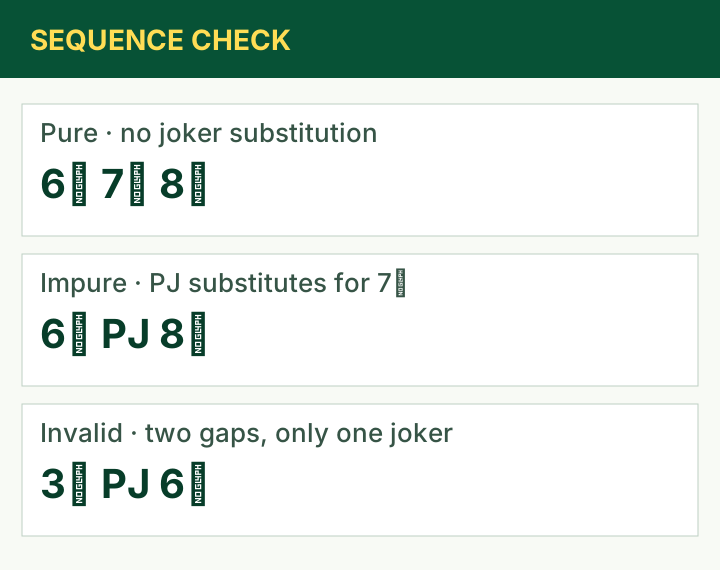
| Example | 6♣–7♣–8♣ | 6♣–PJ–8♣, with PJ representing 7♣ |
| Declaration role | Commonly required at least once | Can satisfy another sequence requirement |
| Main check | Every card fits naturally | Each substitute fills a valid position |
Here, PJ means a printed joker.
A card designated as a wild joker creates an additional question: is it being used as a substitute, or as its own printed rank and suit? Some published rules permit the latter in a pure sequence. A23 describes this natural-use exception, but it should be checked against the rules of the application you actually use. A23 explanation of sequence and joker treatment.
Worked Example 1: A Three-Card Pure Sequence
Consider 3♠–4♠–5♠.
Start with the suits: all three cards are spades. Next, read the ranks in order: three, four, five. There are no gaps and no card is standing in for another.
The group is a pure sequence.
Now change the middle card to 4♦. The ranks still run consecutively, but the suits no longer match. Unless that diamond four is a designated wild joker and substitution is allowed, the group is invalid.
If it is used as a wild substitute for 4♠, the completed run is impure. The distinction comes from how the card is used.
Worked Example 2: A Longer Pure Sequence
Consider 7♦–8♦–9♦–10♦.
All four cards are consecutive diamonds. This is one four-card pure sequence.
It does not count as two separate sequences simply because the first three cards and the last three cards each look like a run. That would use the eight and nine twice.
Each physical card may occupy only one position in your declared grouping. If you want two sequences, you need enough cards to create two separate valid groups.
This is especially relevant when a player holds six or more consecutive cards. Some long runs can be divided into two valid groups, but each resulting group must independently meet the minimum length.
Worked Example 3: A Printed Joker Fills a Gap
Consider 6♣–PJ–8♣.
The six and eight are clubs, and the missing rank between them is seven. The printed joker represents 7♣.
The completed sequence is therefore 6♣–7♣–8♣. Because the joker substitutes for a missing card, the group is impure.
A useful checking method is to state the substitution explicitly. Saying “the joker is seven of clubs” makes it easier to verify that the run is complete.
Do not stop at “there is a joker, so it works.” The remaining cards must still fit a single legal run.
Worked Example 4: A Joker Extends the End
Consider 10♥–J♥–PJ.
The joker can represent Q♥, completing 10♥–J♥–Q♥. It could also represent 9♥, with the group arranged as 9♥–10♥–J♥.
Either interpretation creates an impure sequence under unrestricted substitution.
This illustrates that a joker does not need to fill an internal gap. It can complete an end position.
The chosen interpretation still needs to remain within the app’s ace and sequence rules. A joker cannot make an otherwise prohibited wraparound run valid merely by being flexible.
Worked Example 5: One Joker Cannot Fill Two Missing Positions
Consider 3♦–PJ–6♦.
A consecutive run from three to six requires four positions: three, four, five and six. Your group contains only three cards.
The single joker cannot simultaneously represent both 4♦ and 5♦. The group is invalid under the rules used here.
Adding a second permitted joker would create four cards and could produce 3♦–4♦–5♦–6♦, subject to the table’s restrictions on joker use.
The same principle applies to natural cards from different suits. A joker may fill a missing position, but it cannot change another natural card’s printed identity.
Worked Example 6: A Wild Card Used Naturally
Suppose sevens are designated wild jokers, and you hold 6♠–7♠–8♠.
The seven of spades already occupies its natural position. It does not need to stand in for another card.
Under a ruleset permitting natural use of wild-rank cards in pure sequences, this remains pure.
Now consider 6♠–7♦–8♠. The diamond seven must represent 7♠ to complete the run. That is a substitution, making the sequence impure.
These two groups look similar, but the suit of the seven changes its role. Avoid the blanket assumption that every group containing a wild-rank card is automatically impure.
How Aces Work in Sequences
Under common Indian Rummy conventions, A♣–2♣–3♣ and Q♥–K♥–A♥ can form sequences.
However, K♠–A♠–2♠ is not accepted under the non-wrapping convention used in this guide. An ace can occupy the low end or high end; it does not connect the two ends into a circle.
Check this before using a joker around an ace. For example, K♠–PJ–2♠ does not become valid simply by calling the joker an ace.
Remember also that a natural ace’s position in a sequence and its penalty value are separate matters. A scoring value does not determine whether the run is valid.
A Complete 13-Card Worked Hand
The following example assumes kings are wild, although none are needed.
| Group | Cards | Classification | Count |
|---|---|---|---|
| 1 | 4♥–5♥–6♥–7♥ | Pure sequence | 4 |
| 2 | 9♠–10♠–PJ | Impure sequence; PJ represents J♠ | 3 |
| 3 | Q♣–Q♦–Q♥ | Set of queens | 3 |
| 4 | 2♣–3♣–4♣ | Pure sequence | 3 |
| Total | Every card used once | Complete grouping | 13 |
This hand contains three sequences, including two pure sequences, plus a set. Under the stated conventions, it satisfies the structural requirement of at least two sequences including one pure sequence.
It also shows that an impure sequence is not compulsory when enough pure sequences are available. The requirement concerns qualifying sequences, rather than collecting exactly one of each type. RummyCircle’s published declaration guide makes that distinction. Rummy declaration requirements.
Common Mistakes Before Declaring
One frequent mistake is counting sets as sequences. 8♣–8♦–8♥ is a set because the ranks match. It does not supply a run.
Another is leaving a single card outside otherwise valid groups. Completing two sequences does not excuse an unmatched thirteenth card.
Players also sometimes misread the wild indicator. Confirm which rank is wild for the current deal rather than relying on the previous hand.
Finally, inspect the submitted grouping. An app’s sorting display can help organise cards, but you should understand which cards belong to each group before declaring.
Frequently Asked Questions
Can two pure sequences satisfy the sequence requirement?
Yes, under the common rules used here. The second sequence does not have to be impure.
Can a sequence contain five cards?
Under the stated minimum-three-card convention, a valid five-card run is possible. Confirm any app-specific restrictions.
Does a joker make every group valid?
No. It must represent a legal missing position, and the complete declaration still needs to meet every other requirement.
Do these examples guarantee a valid declaration in every Yono app?
No. They are learning examples, not verified instructions for one identified app. Read the table rules and practise with non-redeemable chips before relying on a grouping during play. Correct rules knowledge reduces mistakes but does not guarantee wins or income.
Sources
Check rank order, suit and joker use, then validate the complete 13-card grouping.