
Short answer: A useful Yono game review identifies the exact application, explains what was examined and provides evidence that supports its conclusions.
What Makes a Yono Game Review Useful?
A title such as “Yono Game Review” is too broad on its own. The word Yono appears in searches for different gaming apps and websites. Similar names do not establish a common developer, shared customer support or identical rules.
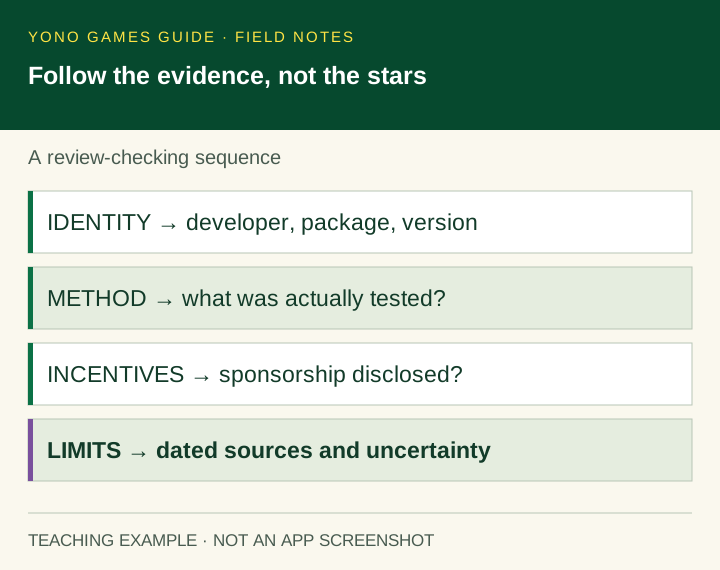
Before relying on a review, determine which product it describes. Then examine its testing method, publication date, financial relationships and claims about safety or rewards.
The goal is not to demand certainty about everything. It is to understand what the reviewer actually knows and where the evidence ends.
Start With App Identity
A credible review should provide enough information to distinguish the app from similarly named products.
| Identity detail | Why it matters |
|---|---|
| Complete app name | Establishes the product being discussed |
| Developer or operator | Identifies the responsible party |
| Android package ID | Distinguishes an Android application |
| Source URL | Shows where the record or file came from |
| Version and review date | Defines the release examined |
| Region and platform | Explains availability and interface differences |
| Game mode | Separates social, arcade and other formats |
Not every review will have every field. Missing details should be acknowledged rather than filled with guesses.
A reviewer who cannot identify the package should avoid claiming that every APK using the name is safe or official.
Separate Testing From Description
A review may contain direct observations, publisher statements and the writer’s opinions. These are different forms of evidence.
“On the tested phone, the app opened in six seconds” describes a measured observation, provided the method is explained.
“The developer advertises offline play” reports a claim. It does not prove offline functionality was tested.
“The interface is easy to use” is an opinion that becomes more useful when supported with examples, such as readable labels and a clear route back to the lobby.
A strong article makes these differences visible in ordinary language. Readers should not have to guess whether a feature was tested or copied from promotional material.
What a Meaningful Test Description Includes
A performance review should identify the phone, operating system, app version, connection type and approximate test duration.
For example, “The app loaded three times on a named Android device over home Wi-Fi, with no crash during a twenty-minute session” is narrow but useful evidence.
It does not support “works perfectly on every phone” or “never crashes.”
Likewise, a short test cannot reliably establish long-term account recovery, consistent customer support or every event’s reward behavior.
Review quality depends more on matching the conclusion to the test than on using an impressive number of technical terms.
Screenshots: Useful Evidence With Limits
Screenshots can show a permission prompt, rules page, score summary or error message. Their usefulness depends on context.
A complete screenshot with the version, date and relevant settings is stronger than a tightly cropped balance.
However, screenshots can be edited, taken from another app or captured from a demonstration account. Their existence does not independently authenticate the application.
For gameplay comparisons, look for the sequence of actions that produced the result. A final score alone cannot show whether boosts, continues or a special mode were used.
For privacy claims, a screenshot of one permission screen cannot reveal every form of data collection.
Sponsorship and Affiliate Links
A review may earn money from referrals, installations, purchases or sponsorship. That relationship does not automatically make every statement false, but readers should know about it when judging the recommendation.
The US Federal Trade Commission’s endorsement guidance explains the importance of disclosing material relationships between advertisers and endorsers. This is US guidance; it is cited here as a transparency reference, not as a statement that US law governs every Yono review.
Look for plain disclosures such as “Sponsored review” or “We may receive a commission if you use this link.”
A vague phrase such as “our partner” may leave readers unclear about payment or editorial influence. Disclosure is most useful near the recommendation or link it explains.
Questions to Ask About a Sponsored Review
The central issue is whether readers can assess the influence of the relationship.
Did the developer provide payment, free virtual currency or early access? Could the sponsor approve the article before publication? Was the reviewer allowed to report problems?
A review need not disclose every private commercial term to be useful. It should explain the nature of the relationship clearly enough that readers understand why the article may encourage a download or registration.
A disclosure also does not replace evidence. An openly sponsored claim can still be unsupported.
Common Unsupported Claims
| Review claim | Evidence needed |
|---|---|
| “100% safe APK” | No ordinary review can guarantee all future safety |
| “Official Yono app” | Verifiable developer and source relationship |
| “Guaranteed daily income” | Such certainty should not be accepted |
| “Instant withdrawals every time” | Broad transaction evidence and current terms; still no guarantee |
| “RNG certified” | Traceable certificate, scope and relevant product |
| “No data collected” | Consistent policy and technical evidence |
| “Best app for everyone” | Defined criteria and meaningful comparisons |
| “Latest version” | Current source record and check date |
A professional layout, star badge or download counter does not supply missing evidence.
How to Judge Payment and Withdrawal Claims
If a review discusses real-money activity, first verify that the identified app actually offers it under current terms. A virtual-chip balance may not represent withdrawable funds.
One successful transaction shows only that a particular transaction apparently completed under particular conditions. It cannot establish that all users will receive the same result, that the operator is legally authorized everywhere or that future withdrawals are guaranteed.
A balanced review should explain fees, eligibility, bonus restrictions, verification requirements and the distinction between pending and completed transactions where those facts are verified.
Do not make a test deposit merely because a reviewer says it is the only way to prove the app is legitimate.
Why Review Dates Matter
A review can become outdated when an app changes ownership, package, permissions, payment model or support arrangements.
A page updated today may still contain screenshots from an older release. Check whether the writer describes what was rechecked.
A meaningful update note might say that the developer identity and privacy policy were reviewed while performance tests still relate to an earlier version.
That is more informative than changing the year in the title and leaving the evidence untouched.
User Ratings and Complaints
User comments can reveal recurring problems, but they need careful interpretation.
Several recent reports describing the same error, version and device condition are more useful than many vague one-line complaints.
Positive ratings can be influenced by rewards or selective prompts. Negative comments can result from misunderstandings, unrelated applications or isolated technical problems.
Look for patterns in specific evidence rather than counting praise and criticism alone. A detailed response from the developer may help, but it should address the issue rather than repeat a generic message.
Worked Example: Comparing Two Reviews
Imagine two articles about an app called “Yono Arcade Example.” This is a fictional product name used only for comparison.
Review A gives five stars, promises daily earnings and includes a Download button. It provides no package ID, test device, screenshots of rules or sponsorship disclosure.
Review B identifies the package and version, describes a thirty-minute gameplay test, records a loading issue and explains that account recovery was not tested. It also discloses that the app developer supplied free virtual credits.
Review B has a financial relationship, but its evidence is still easier to evaluate. Review A’s lack of disclosure does not prove independence, and its strong claims are not supported by a described method.
The lesson is to inspect evidence and incentives together.
A Practical Reading Method
Begin with identity, then move to the review’s strongest recommendation. Ask what evidence directly supports that recommendation.
Next, check the date, platform and tested version. Read the disclosure before following any download or registration link.
Finally, look for limitations and unresolved issues. A review that admits it could not verify a feature may be more useful than one that labels every claim confirmed.
You can stop without reaching a verdict. “Insufficient evidence” is a valid conclusion when the operator or file cannot be reliably identified.
Protect Your Information While Researching
Reading a review should not require sharing an OTP, banking password or identity document.
Avoid “review verification” forms that request payment credentials. Do not install a separate utility to unlock the full article or confirm a rating.
If you ask the reviewer a question publicly, keep account numbers and private support references out of the comment. Scammers can use exposed details to impersonate customer service.
Frequently Asked Questions
Are sponsored Yono game reviews always unreliable?
No. Clear disclosure and verifiable testing can make a sponsored review informative. Sponsorship should be considered alongside the evidence.
Does a high star rating prove an app is safe?
No. Ratings summarize opinions and may not address developer identity, permissions or security.
Can one withdrawal screenshot prove reliability?
No. It does not establish the outcome for other accounts or future transactions.
What should I do when a review cannot identify the developer?
Treat its app-wide safety or legitimacy conclusions as unverified until the identity can be established.
Sources
A useful Yono game review connects each conclusion to a specific application and a clear source or test. It explains sponsorship, records the version examined and acknowledges what remains unknown.
Give more weight to transparent methods and concrete examples than to confident ratings, bonus headlines or repeated claims of guaranteed safety.
Risk note: A review is information, not a guarantee of security, legality or financial results. Verify the specific app independently before installing software, sharing personal information or considering any purchase.