
Short answer: An arcade game score multiplier increases the points awarded for a qualifying action. If an action is normally worth 100 points, a 3× multiplier may make it worth 300.
What Is a Score Multiplier in an Arcade Game?
The key word is “qualifying.” A multiplier may apply to enemy defeats, collected items, successful matches or timed actions while leaving other score components unchanged.
Different arcade games use different formulas. A label such as 2× does not reveal whether the effect applies to the next action, the current combo, an entire level or only a specific target.
For readers researching Yono arcade games, the same caution applies: similar names do not establish a shared scoring system. Use the rules of the exact game and mode.
All calculations below use fictional games and point values.
Base Points, Multipliers and Bonuses
The base score is the number of points an action earns before adjustments. A multiplier scales that amount. A bonus adds points or provides another benefit.
These terms can look similar on screen, but they do different mathematical jobs.
| Component | Example | Effect |
|---|---|---|
| Base points | Target worth 100 | Starting score value |
| Multiplier | 3× target score | Turns 100 into 300 |
| Flat bonus | +50 points | Adds a fixed amount |
| Percentage bonus | +20% | Adds a proportion of an eligible amount |
| Combo count | 12 consecutive hits | Tracks a chain; may affect a multiplier |
| Event points | 5 tokens per objective | May belong to a separate total |
A combo count of twelve does not automatically mean a 12× multiplier. The game may increase the multiplier only after specific thresholds.
Worked Example: One Action With a Multiplier
Suppose a target has a base value of 150 points and the current multiplier is 4×.
Action score = 150 × 4 = 600 points
If the score before the hit was 2,000, the updated total becomes 2,600.
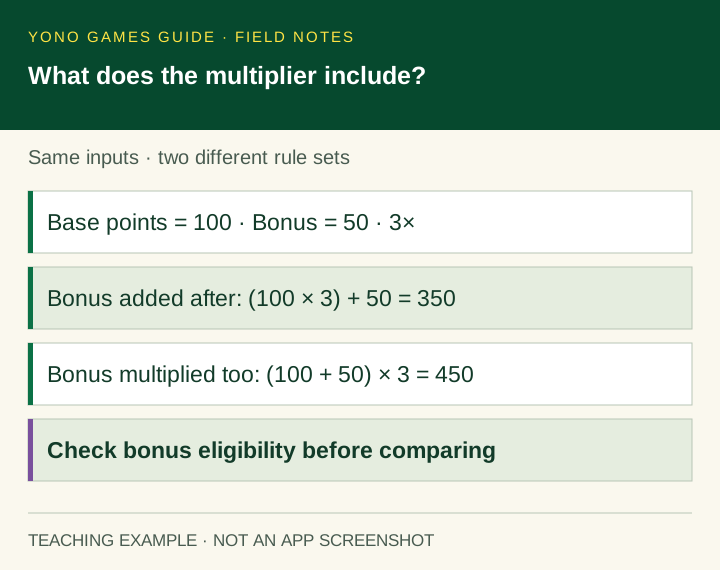
Now assume the game also awards an unmultiplied accuracy bonus of 75 points.
Total added = 600 + 75 = 675 points
The new score becomes 2,675.
If the accuracy bonus were included inside the multiplier, the result would instead be:
(150 + 75) × 4 = 900 points
Both formulas are possible game designs. Only the published scoring rule tells you which one applies.
How Combo Multipliers Increase
A combo is a chain of qualifying actions completed without breaking a condition. That condition might involve timing, accuracy, avoiding damage or continuing to hit targets.
Consider this fictional ladder:
| Consecutive qualifying actions | Active multiplier |
|---|---|
| 1–4 | 1× |
| 5–9 | 2× |
| 10–14 | 3× |
| 15 or more | 4× |
Assume each action is worth 100 base points and the new multiplier applies immediately to the action that reaches the threshold.
For twelve successful actions, the score is:
First four: 4 × 100 × 1 = 400
Next five: 5 × 100 × 2 = 1,000
Final three: 3 × 100 × 3 = 900
Total = 2,300 points
Multiplying all twelve actions by the final 3× value would incorrectly produce 3,600 points. That would be valid only if the game explicitly applies the final multiplier retroactively.
What Breaks a Combo?
A combo can end when the player misses, takes damage, waits too long, touches an obstacle or uses a particular action.
Some games reset the multiplier to 1×. Others reduce it by one level, freeze it temporarily or preserve part of the chain through a shield.
The rule matters because two runs with the same number of successful actions can have different scores.
For example, twelve hits in one uninterrupted chain may earn more than two separate chains of six. The shorter chains spend more time at the lower multiplier levels.
A good score explanation should identify both what builds the combo and what breaks it.
Worked Example: A Combo Reset
Use the same fictional ladder and 100-point targets.
The player completes six hits, misses, then completes another six. Each six-hit chain produces:
Four hits at 1× = 400 points
Two hits at 2× = 400 points
One six-hit chain = 800 points
Two chains produce 1,600 points before any miss penalty.
That is 700 fewer points than the uninterrupted twelve-hit example. The difference comes from the multiplier progression, not from fewer successful targets.
If the game deducts points for a miss, the final gap is larger. If it merely reduces the multiplier rather than resetting it, the calculation changes again.
How Multiple Multipliers Combine
Two active boosts do not automatically multiply together.
Suppose a base action is worth 100 points, a combo shows 3× and a temporary power-up shows 2×.
| Combination rule | Calculation | Points |
|---|---|---|
| Multiplicative stacking | 100 × 3 × 2 | 600 |
| Additive boosts above baseline | 100 × [1 + 2 + 1] | 400 |
| Highest multiplier only | 100 × 3 | 300 |
The additive example treats 3× as a 200% increase and 2× as a 100% increase. Together they create a 300% increase above the original amount, giving 4× overall.
A game may use a different additive convention, impose a cap or prevent boosts from overlapping. The label “stackable” needs a formula or worked explanation.
Temporary Boosts and Timing
A timed multiplier may begin when an item is collected, when an animation ends or when the next round starts. Its countdown may continue during pauses or transitions.
Check whether the effect expires before or after an action’s score is calculated. A target hit at the edge of the timer can be scored differently depending on the event order.
Avoid assuming that a visible boost icon guarantees the score change has already become active. The final result log, if available, is more useful than a single animation frame.
This is a reason to compare repeated controlled examples before calling an unfamiliar result incorrect.
End-of-Level Bonuses
Arcade games may add points for time remaining, accuracy, unused lives or completing secondary objectives.
Assume a fictional level awards:
- 4,000 action points.
- 600 time-bonus points.
- 200 completion points.
If a level-wide 2× effect applies only to action points, the total is:
4,000 × 2 + 600 + 200 = 8,800
If it applies to the entire subtotal, the total is:
(4,000 + 600 + 200) × 2 = 9,600
A guide that says “double your score” without specifying eligible components leaves out the most important detail.
Rounding and Maximum Scores
Fractional calculations can also create small differences.
Suppose three actions are worth five points each and a 1.5× effect applies. Rounding each adjusted action down produces seven points per action, or 21 total.
Adding the base points first and rounding only at the end produces:
15 × 1.5 = 22.5, rounded down to 22
Neither result is inherently wrong. The game’s rounding procedure decides.
Multiplier caps and score caps create another limit. Reaching a higher combo may stop increasing the multiplier after a certain point, even while the combo counter continues rising.
Why Your Leaderboard Score May Differ
The large number shown during play might be a provisional score. The submitted leaderboard value may exclude bonus items, apply penalties or use only the best completed run.
Practice mode, assisted mode and runs using continues may also have separate eligibility rules.
Before reporting a discrepancy, compare the final summary with the leaderboard’s scoring definition. Record the mode, difficulty, active boosts and whether a continue was used.
Do not assume every point displayed in the interface belongs to the ranked score.
Frequently Asked Questions
Does a 10-hit combo mean a 10× multiplier?
No. Combo length and multiplier strength are separate values unless the rules directly connect them.
Does 2× double all points?
It doubles only the score components covered by that effect.
Can buying a boost guarantee a top rank?
No. A boost may affect scoring, but leaderboard position also depends on eligibility, other players and the ranking rules.
Why did my multiplier disappear?
A miss, damage event, timeout, level transition or expired power-up may have ended it.
To understand an arcade score multiplier, identify the base points, eligible actions, progression thresholds, reset conditions and stacking formula. Then check end-of-level bonuses and rounding.
The most useful approach is to calculate one action and one short chain before interpreting an entire run. That makes unexpected score differences easier to explain.
Spending note: Points are not automatically redeemable value. Treat optional boosts as entertainment purchases, and set a limit before buying items to improve a score.